Informath
Informath: Informalization and Autoformalization of Formal Mathematics
(c) Aarne Ranta 2025-2026
LATEST NEWS
4 March 2026: Binary release, entitled Informath-0.2.
Documentation
This README: using Informath with ready-made binaries and grammars.
Informath Under the Hood. Recommended if you want to change the GF grammar and not just the symbol table.
Video from MCLP conference at Institut Pascal, Paris Saclay, September 2025
Updated slides shown in Saclay, Prague, and some other places in 2025
InformathAPI haddock-generated documentation
Symbolic Informalization: Fluent, Productive, Multilingual (by A. Ranta, AITP-2025, extended abstract)
Multilingual Autoformalization via Fine-tuning Large Language Models with Symbolically Generated Data, by Pei Huang, Nicholas Smallbone and Aarne Ranta, SCML Vol. 1, 2025.
The Informath project
The Informath project addresses the problem of translating between formal and informal languages for mathematics. It aims to translate between multiple formal and informal languages in all directions:
- formal to informal (informalization)
- informal to formal (autoformalization)
- informal to informal (translation, via formal)
- formal to formal (works in special cases)
The formal languages included are Agda, Rocq (formerly Coq), Dedukti, and Lean. The informal languages are English, French, German, and Swedish.
Here is an example statement involving all of the currently available languages. The Dedukti statement has been used as the source of all the other formats.
Dedukti: prop110 : (a : Elem Int) -> (c : Elem Int) ->
  Proof (and (odd a) (odd c)) ->
  Proof (forall Int (b => even (plus (times a b) (times b c)))).

Agda: postulate prop110 : (a : Int) -> (c : Int) ->
  and (odd a) (odd c) ->
  all Int (\ b -> even (plus (times a b) (times b c)))

Rocq: Axiom prop110 : forall a : Int, forall c : Int,
  (odd a /\ odd c -> forall b : Int, even (a * b + b * c)) .

Lean: axiom prop110 (a c : Int) (x : odd a ∧ odd c) :
  ∀ b : Int, even (a * b + b * c)
-
English: Prop110. Let $a$ and $c$ be integers. Assume that $a$ and $c$ are odd. Then $a b + b c$ is even for all integers $b$.
-
French: Prop110. Soient $a$ et $c$ des entiers. Supposons que $a$ et $c$ sont impairs. Alors $a b + b c$ est pair pour tous les entiers $b$.
-
German: Prop110. Seien $a$ und $c$ ganze Zahlen. Nimm an, dass $a$ und $c$ ungerade sind. Dann ist $a b + b c$ gerade für jede ganze Zahl $b$.
-
Swedish: Prop110. Låt $a$ och $c$ vara heltal. Anta att $a$ och $c$ är udda. Då är $a b + b c$ jämnt för alla heltal $b$.
Any of the natural languages could also in principle be used as the source, if written in the same LaTeX code as Informath produces. However, the translation will usually produce some garbage, which can only be excluded by type checking in Dedukti. Moreover, there are some language-specific lexing and parsing issues that have not been completely solved, especially for the LaTeX parts of text and for other languages than English.
More formalisms and informal languages will be added later. Also the scope of language structures is at the moment theorem statements and definitions; proofs are included for the sake of completeness, but will require more work to enable natural verbalizations.
Using Informath
From ready-made binaries
For this method, you don’t need GF or Haskell. It is available for MacOS-ARM and Linux-x86.
The quickest way to use Informath is to
- go to the release page
- download and uncompress the binary
RunInformathfor you OS architecture and put it into some place on your path of executables; make sure its name isRunInformath. - clone this Git repository (recommended) or download the source
.tgzpackage from the release page and unpack it - download and unpack the OS-independent grammar package
Informath-grammars.tgz, and move the two .pgf files to theshare/directory of this Git repository. OnlyInformathEng.pgfis needed if you don’t aim to use other languages. - point the environment variable
INFORMATH_ROOTto the directory namedinformath, which is the root of this Git repository and the unpacked source packageexport INFORMATH_ROOT=<path_to_informath>After that, you can do
$ echo "c : Proof (Eq (plus 2 2) 4)." | RunInformath -variationsfor a very quick example, or
$ make demofor many more examples. If you are not on a Mac, you will have to change the variable OPEN in the Makefile to point to the command you use for opening .pdf files. You should also make sure that the LaTeX packages
amsfonts,amssymb, andamsmathare available for your LaTeX processing.
The former uses only English, but if you want to see something more in another language (Fre, Ger, Swe), also do e.g.
$ make lang=Fre fulldemo
To see all options available in RunInformath, do
$ RunInformath -help
Notes added after release
- If you are on a Mac, you may be blocked by a message saying that you cannot run software from untrusted source. There is a solution for this in security setting, described in Mac support.
Compiling from source
If you cannot use a ready-made binary, do
$ make
to build the executable RunInformath and all its dependencies.
You will need to set the environment variable INFORMATH_ROOT to point to the directory where the share/ directory resides (the same as where this README.md resides).
After that, you can do
$ make demo
which illustrates different functionalities: translating between Dedukti and natural languages, as well as from Dedukti to Agda, Rocq, and Lean.
Building the system from source requires the following software:
- GF >= 3.12 (both as executable and as the PGF library)
- GF-RGL (the Resource Grammar Library, to be compiled from its GitHub source)
- BNFC >= 2.9 (executable)
- GHC >= 9.6 (executable, with some common libraries)
- alex (executable, tested with 3.5.4)
- happy (executable)
Some test datasets
The following datasets can be processed with RunInformath <filename> to generate text or code eveb without additional options; see RunInformath -help to see what can be done with various options.
-
test/exx.dk is a set of simple arithmetic statements.
-
test/gf-lean.data is a set of arithmetic statements in natural language, extracted from the textbook Mathematical Proofs: A Transition to Advanced Mathematics by Chartrand et al, used in Pathak’s GFLean project. Some statements in this set are not yet parsed or interpreted correctly.
-
test/naproche-zf-set.tex is a set of de Lon’s Naproche-ZF statements. Try
make naprocheto directly display a LaTeX document. Usemake lang=Fre naprocheto generate French (and similarly for Ger, Swe). Some statements are not yet parsed or interpreted correctly. -
test/sets.dk contains set algebra statements from a Wikipedia article. Try
make setsto directly display a LaTeX document. Usemake lang=Fre setsto generate French (and similarly for Ger, Swe). -
test/sigma.dk contains some examples of variable-binding constructs (sums, integrals). Try
make sigmato directly display a LaTeX document. -
test/top100.dk contains a selection of Wiedijk’s “100 theorems”. Try
make top100to directly display a LaTeX document. Usemake lang=Fre top100to generate French (and similarly for Ger, Swe). -
datasets/smad.tar.bz2 contains the synthetic data used in the autoformalization experiment of Huang et al.
-
test/natural.tex contains the manually written top100-statements used for evaluating autoformalization in Huang et al.
Possible input and output formats formats
Use RunInformath -help to see the actually available file types and extensions. You can also use RunInformath on standard input, for instance,
$ echo "prop1 : Proof (forall Num (n => if (even n) (not (odd n))))." | RunInformath
Prop1. If $n$ is even, then $n$ is not odd for all numbers $n$.

$ echo "prop2. Every number is even or odd." | RunInformath -formalize
prop2 : Proof (forall Num (_h0 => or (even _h0) (odd _h0))) .
The option -loop allows you to translate between individual Dedukti and natural language judgements:
$ RunInformath -loop
> prop1 : Proof (forall Nat (n => if (even n) (not (odd n)))).
Prop1. If $n$ is even, then $n$ is not odd for all natural numbers $n$.
> ? prop2. Every number is even or odd.
prop2 : Proof (forall Num (_h0 => or (even _h0) (odd _h0))) .
>
Input prefixed with ? is treated as natural language, all other input as Dedukti.
You can change the source and target languages with the -from-lang and -to-lang flags.
You can quit the loop with Ctrl-C.
Generating synthetic data
For those who are interested just in the generation of synthetic data, the following commands (after building Informath with make) can do it: assuming that you have a .dk file available, build a .jsonl file with all conversions of each Dedukti judgement:
$ RunInformath -parallel-data <file>.dk > <file>.jsonl
After that, select the desired formal and informal languages to generate a new .jsonl data with just those pairs:
$ python3 ./scripts/jsonltest.py <file.jsonl> <formal> <informal>
The currently available values of <formal> and <informal> are the keys in <file>.jsonl - for example, agda and InformathEng, respectively.
An example is datasets/smad.tar.bz2, which contains the synthetic data used in the autoformalization experiment of Huang et al.. It was generated with an earlier version of Informath in Spring 2025. But the Dedukti statements contained in it can be used for generating data with later versions.
The files in this repository
In the root, you have
- Makefile, with entries for building the software as well as different demos and tests
The src directory contains
- Haskell and other sources
- subdirectory in typetheory with generated parser and printer for the proof systems Dedukti, Agda](https://wiki.portal.chalmers.se/agda/pmwiki.php), Rocq, and Lean
- a translator from MathCore to Dedukti and vice-versa
- translations between MathCore and Informath
The share directory contains
- file BaseConstants.dk of logical and numeric operations assumed in most of the data examples, and correspoonding files for Agda, Rocq, and Lean
- file baseconstants.dkgf, a symbol table for converting Dedukti constants in BaseConstants.dk to GF abstract syntax functions
- binary file
InformathEng.pgf, the runtime grammar with only English, when generated or copied - binary file
InformathFull.pgf, the runtime grammar with all available languages, when generated or copied; this is much larger and somewhat slower to use than the English-only version (you can also build a smaller one withmake multi_grammarfor just the languages you want; edit the Makefile entry to select the languages)
The test directory contains
- some test data as
.dk,.tex, and.txtfiles (see above)
The grammars directory contains
- MathCore, the abstract syntax of a minimal CNL for mathematics
- MathCoreEng, Fre, Ger, Swe - concrete syntaxes of MathCore
- [MathExtensions(./grammars/MathExtensions.gf), an extension of MathCore with alternative expressions, and corresponding concrete syntaxes
- WikidataWords, lexicon of natural language words usable mathematical concepts
- ProperNames, a lexicon of mathematicians’ names that appear in mathematical constants, such as “Hilbert space”
- VerbalConstants, a small lexicon of natural language mathematical concepts
- SymbolicConstants, a small lexicon of symbolic concepts in LaTeX.
- Terms, grammar of formal notations, with a single concrete syntax TermsLatex
- UserExtensions, user-definable extension modules, such as Naproche, NaturalDeduction, HoTT, Godement
- Utilities, auxiliary functions and type synonyms used in other modules, also usable in user extensions
- Examples, grammar rules for building lexical items for symbol tables and parsing them from examples (see below under symbol tables)
- Informath, the top module that puts everything together
In addition to the above grammars, which are used in the actual runtime, there are directories that can be used as libraries for implementing new constants:
- grammars/mathterms, multilingual mathematics lexicon extracted from Wikidata
- grammars/extraction, auxiliary grammars used for the extraction task and also imported in the lexicon modules
However, much of this is also available by combining lexical items in symbol tables (see the last section of this document).
The scripts directory contains
- Python scripts for various tasks in the development of Informath
The structure of Informath
The structure of Informath is shown in the following picture:
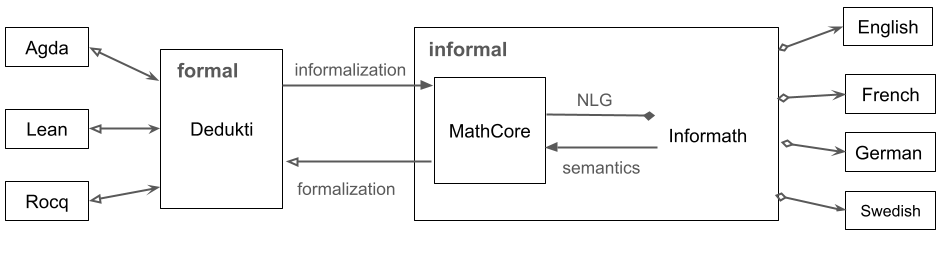
The diagram has four kinds of arrowheads. Solid ones mean that the operation is a total function, giving exactly one result for every input (triangular arrowheads) or possibly many (diamond). Hollow arrowheads mean partial functions which can likewise give at most one result (triangular) or many results (diamond):
- Conversions from Dedukti to Agda, Rocq, and Lean are partial, because Dedukti is more permissive than these formalisms.
- Conversion from MathCore to Dedukti may fail because MathCore is more permissive than Dedukti; this is because we delegate dependent type checking to Dedukti.
- Conversion from MathCore to Informath is one-to-many, and always results in at least one value, the MathCore expression itself.
- Conversions from English and other natural languages to Informath may fail, because the input is not covered by the grammar. They can also give many results, because the grammar accepts ambiguity; the idea is that ambiguity is ultimately checked on semantic grounds in Dedukti.
Conversions between MathCore and Informath, and extending the Informath language itself, are the most open-ended parts of the project and hence the main research focus.
Conversions from Dedukti to Agda, Coq, and Lean and back are mostly engineering (although tricky in some cases) that has to a large extent been done for the kind of code needed in Informath. Conversions from these type theories to Dedukti rely on already existing third-party tools. Those tools are not always up to date with the latest versions of the systems, but they have their own development teams that have goals independent of Informath.
Processing in type theory
Type checking in Dedukti
The type checking is based on the file BaseConstants.dk, which is meant to be extended as the project grows. This file type checks in Dedukti with the command
$ dk check BaseConstants.dk
The example file test/exx.dk assumes this file. As shown in make demo, it must at the moment be appended to the base file to type check:
$ cat BaseConstants.dk test/exx.dk >bexx.dk
$ dk check bexx.dk
Since this is cumbersome, we will need to implement something more automatic in the future. We also plan to use Dedukti for type selecting among ambiguous parse results by type checking, and Lambdapi (a syntactically richer version of Dedukti with implicit arguments) to restore implicit arguments.
Generating other type theories
Each of Agda, Rocq, and Lean will be described below. A common feature to all of them are the conversion rules of constants stored in BaseConstants.dk, with the format as in
#CONV agda forall all
#CONV rocq forall All
#CONV lean forall All
The purpose of these conversions is to
- avoid clashes of the target systems’ reserved words
- map Dedukti to standard libraries of these systems
- comply to the identifier syntax of each system
The last purpose might be better served by a generic conversion, but that remains to be done.
Generating and type checking Agda
There a simple generation of Agda from Dedukti. At the moment, it is only reliable for generating Agda “postulates”. The usage is
$ RunInformath -to-formalism=agda <file>
where the file can be either a .dk or a text file.
As shown by make demo, this process can produce valid Agda code:
$ RunInformath -to-formalixm=agda test/exx.dk >exx.agda
$ agda --prop exx.agda
The base file BaseConstants.agda is accessed by an open import statement.
Generating and type checking Rocq
Generation from Dedukti is similar to Agda, but type checking requires at the moment concatenation with BaseConstants.v:
$ RunInformath -to-formalism=rocq test/exx.dk >exx.v
$ cat BaseConstants.v exx.v >bexx.v
$ coqc bexx.lean
This should be made less cumbersome in the future.
Generating and type checking Lean
Just like in Rocq, type checking requires at the moment concatenation with BaseConstants.lean:
$ RunInformath -to-formalism=lean test/exx.dk >exx.lean
$ cat BaseConstants.lean exx.lean >bexx.lean
$ lean bexx.lean
This should be made less cumbersome in the future.
Symbol tables
You can generate natural language from any Dedukti (.dk) file, at least if it is well typed in Dedukti (which is not always necessary). However, the result will be quite bad unless you provide a symbol table with a .dkgf file, mapping Dedukti identifiers to GF functions. For example, the line
abs : absolute_value_Fun | absolute_value_Oper
maps the Dedukti function abs to absolute_value_Fun, which generates verbal expressions of the form “the absolute value of $x$”, and to absolute_value_Oper, which generates symbolic expressions of the form “$|x|$”.
This section explains how symbol tables work and how you write your own ones. If you work with the binary-only distribution of Informath, you can apply it to much of your formal code by just writing symbol tables; there is no need to change the grammar and, even less, the Haskell code.
There is a default symbol table, baseconstants.dkgf, which works for the examples listed in this README. But for other Dedukti files, it can give strange results or even processing errors because of name clashes between that file and the default symbol table. The first aid to this is to use the empty symbol table, by passing it to the flag -symboltables. An example is the conversion of a Matita dump:
$ RunInformath -symboltables=test/empty.dkgf test/mini-matita.dk
If you don’t want to replace baseconstants.dkgf but just add your own .dkgf files to it, you can use the flag -add-symboltables. Your own entries override the ones in baseconstants.dkgf.
Thus the mapping between Dedukti and GF is defined in .dkgf files, by default in baseconstants.dkgf, which assigns GF functions to the constants in BaseConstants.dk. The syntax of .dkgf files has several kinds of lines, the most important of which is the mapping of Dedukti constants to GF functions:
<DeduktiIdent> : <GFFunction> | ... | <GFFunction>
This line maps the Dedukti identifier to the different GF functions usable for expressing the Dedukti concept; the first one is consireded primary and the other ones are optional synonyms.
The GF functions can be given explicitly as abstract syntax identifiers. But there is also a more natural way: by giving verbal strings that show how a function is applied to its arguments. For example, the line
disj : "X is disjoint from Y" | "X and Y are disjoint" | \isdisjoint
says that an application of the Dedukti constant disj to two arguments $X$ and $Y$ is primarily rendered “$X$ is equal to $Y$”. The second alternative, uses the collective predication form “$X$ and $Y$ are disjoint”. The third alternative \disjoint uses the LaTeX macro expression \isdisjoint{X}{Y}, which creates a symbolic expression in LaTeX’s math mode (between dollar signs).
In these symbol table lines, the first variant must always be a verbal function, that is, use words instead of mathematical symbols. This condition is needed to make informalization failure-free: a symbolic function can only be used if all of its arguments have symbolic renderings, which is not guaranteed for all concepts in informal mathematics.
A GF function in a symbol table can be of any of the three kinds:
- a natural-language expression in quotes, e.g.
"X is disjoint from Y" - a GF abstract syntax expression from the Informath grammar, e.g.
disjoint_AdjC - a LaTeX macro, e.g.
\isdisjoint
In addition to mappings from Dedukti to GF, a .dkgf file can contain the following kind of lines:
#MACRO <latex_newcommand>
defines a LaTeX macro, which can be used on lines that map Dedukti identifiers to GF. The \newcommand directive on this line is included in the file generated with the -to-latex-doc option. For example, the mapping
congruent : congruent_Adj3 | \congruent
gives, as the primary rendering, the three-place adjective producing “$m$ is congruent to $n$ modulo $k$”. The second alternative is a macro, which is defined as a LaTeX \newcommand directive,
#MACRO \newcommand{\congruent}[3]{#1 \equiv #2 \, \text{mod} \, #3}
This produces the rendering “$m \equiv n \, \text{mod} \, k$”.
The symbol table line
#DROP <DeduktiIdent> <int>
tells the conversion from Dedukti to GF to drop a number of initial arguments of the function application. These are typically the “hidden arguments” in some other formalism, which Dedukti has to make explicit.
#CONV <formalism> <DeduktiIdent> <FormalismIdent>
defines a conversion of a Dedukti identifier to another formalism, such as Lean, typically to a standard library function of that formalism.
#BUILTIN <DeduktiIdent>+
lists Dedukti identifiers that have built-in mappings in Informath’s Haskell code. These lines are included to prevent spurious warnings when checking the symbol table. In baseconstants.dkgf, they include digits and a few other functions.
The coverage of Informath can thus be extended by writing a .dkgf file that maps Dedukti identifiers to GF functions. If those GF functions are already available, nothing else is needed than the inclusion of the flag -symboltables=<file>.dkgf+. The flag -add-symboltables=<file.dhf>+ includes base_constants.dkgf as one of the files.
How to define new GF functions is covered in the under the hood document. But this should not always be necessary, at least for English, which has a large lexicon that supports the parsing of strings into symbol table entries.
Syntactic and lexical categories
A majority of Dedukti expressions are function applications (of the form f x1 ... xn), which are rendered in a category determined by the symbol table mapping of the function f. The resulting informalizations belong to one of the following syntactic categories in GF:
category   name              linguistic type     example
—-------------------------------------------------------------------------
Exp        expression        NP (noun phrase)    the empty set
Kind       kind              CN (commoun noun)   integer
Prop       proposition       S (sentence)        2 is even
Proof      proof             Text                by Theorem 1, x is prime
ProofExp   theorem label     NP                  Theorem 1
Term       symbolic term     TermPrec            x + 2
Formula    symbolic formula  TermPrec            x > 2
The “linguistic type” here refers to a type in the GF Resource Grammar Library (RGL), which is used in the implementation of the grammar. The category TermPrec means term with a precedence level, where a small integer controls the use of parentheses in combinations.
Unless you are willing to modify the GF grammars and the Haskell code, you will never have to write the name of a syntactic category. The most intuitive way to adapt Informath to your Dedukti files is by using example-based symbol table entries. The things you need to know are
- the intended target type of your Dedukti constant:
- if its value type in Dedukti is
Prop, it isProp - if its value type in Dedukti is
Set, it isKind - if its value type in Dedukti is
Elemfor some set, it isExp
- if its value type in Dedukti is
- its arity, i.e. the number of argument it takes (after possibly dropping some initial arguments not to be shown in informal text)
Given this information, you can use the following formats to write symbol table entries:
Prop, arity 1:
    "X is <Adj>"
  | "X <Verb>s"
  | "X is a <Noun>"
Prop, arity 2:
    "X is <Adj> <Prep> Y"
  | "X and Y are <Adj>
  | "X <Verb>s <Prep> Y"
  | "X is a <Noun> <Prep> Y"
  | "X and Y <Verb>"
  | "X and Y are <Noun>s"
Prop, arity 3:
    "X is <Adj> <Prep> Y <Prep> Z"

Kind, arity 0:
    "<Noun>"
Kind, 1 Kind argument (type constructor):
    "<Noun> <Prep> As"
Kind, 1 Exp argument (dependent type):
  | "<Noun> <Prep> X"
Kind, 2 Kind arguments:
    "<Noun> <Prep> As <Prep> Bs"
Kind, 2 Exp arguments:
  | "<Noun> <Prep> X <Prep> Y"
  | "<Noun> <Prep> X and Y"

Exp, arity 0:
    "the <Noun>"
Exp, arity 1:
    "the <Noun> <Prep> X"
Exp, arity 2:
    "the <Noun> <Prep> X <Prep> Y"

Exp, higher order argument x => X (Ident x bound in Exp X):
    "the <Noun> X of $x$"
Exp, arguments A, x => X (A is a Kind that x ranges over):
    "the <Noun> of X where $x$ is an A"
Exp, arguments X, Y, x => Z (X and Y are bounds; e.g. sum, integral):
    "the <Noun> of Z where $x$ ranges from X to Y"

ProofExp:
    "<Noun> ."
  | "the <Noun> ."
  | "<Noun> <Int> ."
  | "<Noun> <Ident> ."
  | "the <Noun> of <Noun> ."
  | "<ProperName>'s <Noun> ."
The variable names X, Y, Z, A, B, x used in the examples are special constants included in the grammar for parsing examples.
Therefore, you must use some of them and no other symbols, whereas the category symbols <Adj>, <Noun>, etc range over all words included in the Informath grammar.
So, what are these placeholders <Adj>, <Noun>, <Prep>, <Verb>, <ProperName>, <Ident>, <Int>?
All but the last two are lexical categories, that is, categories of individual words such as “integer” and multiword phrases such as “natural number”.
<ProperName>s are typically last names of mathematicians, such as “Fermat”, “Hilbert”; there is a list of them in the grammar file ProperNames.gf.
<Ident>s are identifiers such as “h”.
<Int>s are non-negative integer expressions.
Informath comes with a large lexicon (of 3000 entries in English, plus over 300 proper names), from which you often pick the ones that you need in your symbol table. The lexicon consists of individual words, but they can be combined with the following rules:
<Adj>:
    <Adverb> <Adj>
<Noun>:
    <Adj> <Noun>
  | <Noun> <Noun>
  | <ProperName> <Noun>
<Verb>:
    <Verb> <Prep> a <Noun>
  | <Verb> <Prep> <Noun>s
  | <Verb> <Prep> the <Noun>
Notice that these rules are inductive: they permit the formation of infinitely many multiword expressions. For a (nonsensical) example,
uniformly closed topological Hilbert      space
<Adv>     <Adj>  <Adj>       <ProperName> <Noun>
is a <Noun>.
You can test a candidate symbol table entry with the -parse-example flag:
$ echo "X is disjoint from Y" | RunInformath -parse-example

AdjPrepAdj2 disjoint_Adj fromPrep
If a result is shown, the entry is possible to use.
You can also paste the result to your symbol table instead of using a string; this can make later processing a little bit faster.
More importantly, if the command gives many alternatives, this is a reliable way to choose the desired one of them.
(The baseconstants.dkgf symbol table uses explicit GF abstract syntax expressions in order to be fast and unambiguous.)
The words used internally in Informath are abstract syntax functions that follow a uniform naming convention:
<word>_<category>
For example,
even_Adj
integer_Noun
converge_Verb
Binder expressions
The complicated-looking expression forms such as
Exp, arguments X, Y, x => Z (X and Y are bounds; e.g. sum, integral):
    "the <Noun> of Z where $x$ ranges from X to Y"
are meant for binders, which take higher-order function applications to linear terms. A typical example is
$\Summa {1}{\infinity}{n}{\frac{ 1}{2 ^ {n}}}$.
where the variable $n$ is bound in the summation term. The (usually avoided) verbal expression is
- The sum of the quotient of $1$ and the square of $n$ where $n$ ranges from $1$ to the infinity.
These expressions are generated from the Dedukti expression
sigma (nd 1) infinity (n => div 1 (square n))
via the symbol table entry
sigma : "the sum of Z where $ x $ ranges from X to Y" | '\\Summa'
The syntax of bindings definable in symbol tables is still an experimental feature, and not yet general enough for all common cases.
Inspecting the Informath lexicon
The Informath lexicon contains entries from each of the lexical categories.
It can be inspected with RunInformath itself by using the flag -find-gf:
$ echo "vector orthogonal" | RunInformath -find-gf

vector : vector_Noun
orthogonal : orthogonal_Adj
This command reads standard input and treats every word separately.
Another view of the lexicon (and the whole grammar) can be obtained by the option -all-gf-functions, which lists all functions of the grammar with their types, as well as the languages for which they are implemented. Grepping with the category and the language focuses the view to what you are looking for:
$ RunInformath -all-gf-functions -to-lang=Ger | grep Adj | grep Ger

continuous_Adj : Adj 	 Eng Fre Ger
orthogonal_Adj : Adj 	 Eng Fre Ger Swe
perpendicular_Adj : Adj 	 Eng Fre Ger Swe
(showing a small part of the result). To see what the rendering of a given function is in a given language, you can use the -linearize option:
$ echo "continuous_Adj" | RunInformath -linearize -to-lang=Ger

stetig
Type checking symbol tables
It is important that the types of Dedukti functions and GF functions match, at least in terms of arity; otherwise, informalization may cause run-time failures. Because of this, RunInformath provides a static checker of symbol tables, invoked as follows:
$ RunInformath -base=<file.dk> <file>.dkgf
This command checks if the types of the GF functions and symbolic macros are compatible with the types of the Dedukti functions that they are assigned to. It does not (yet) find all errors, but it can in most cases guarantee that informalization is failure-free.
Fine-grained lexical categories
This section is becoming less relevant for users not writing grammars themselves, now that lexical entries can be given by parsing strings.
The following lexical categories are available for verbal renderings. The “example” column shows how an item of this category behaves in linearizing an application of it to its arguments. At the same time, it shows how the item can be given as a string in a symbol table, which is a “no-code” method for building symbol tables.
category  semantic type              example
—----------------------------------------------------------------------------------
Adj       Exp -> Prop                X is even
Adj2      Exp -> Exp -> Prop         X is divisible by Y
Adj3      Exp -> Exp -> Exp -> Prop  X is congruent to Y modulo Z
AdjC      Exps -> Prop               X and Y are distinct
AdjE      Exps -> Prop               X and Y are equal EQUIVALENCE
Binder    (Exp->Exp) -> Exp          the function sum of X of $x$
Binder1   Kind -> (Exp->Exp) -> Exp  the disjoint union of X where $x$ is an A
Binder2   Exp->Exp->(Exp->Exp)->Exp  the integral of Z where $x$ ranges from X to Y
Dep       Exp -> Kind                root of X
Dep2      Exp -> Exp -> Kind         interval from X to Y
DepC      Exps -> Kind               path between X and Y
Fam       Kind -> Kind               list of As
Fam2      Kind -> Kind -> Kind       function from As to Bs
Fun       Exp -> Exp                 the square of X
Fun2      Exp -> Exp -> Exp          the quotient of X and Y
FunC      Exps -> Exp                the sum of X and Y
Label     ProofExp                   theorem 1 .
Name      Exp                        the empty set
Noun      Kind                       integer
Noun1     Exp -> Prop                X is a prime
Noun2     Exp -> Exp -> Prop         X is a divisor of Y
NounC     Exps -> Prop               X and Y are relative primes
Verb      Exp -> Prop                X converges
Verb2     Exp -> Exp -> Prop         X divides Y
VerbC     Exps -> Prop               X and Y coincide
The category Exps contains non-empty lists of expressions. The last two expressions of the list are combined with the conjunction “and” or its equivalents in different languages.
The token EQUIVALENCE in the AdjE example is used for marking the operator as an equivalence relation, which has certain NLG properties that AdjC does not have. The token EQUIVALENCE does not appear in the linearization of the application, but is needed in example-based parsing to distintuish it from AdjC.
Most of the words in the Informath lexicon belong to the base categories Adj, Noun, and Verb. Complex categories such as Adj2 and Fun have very few entries.
There are three reasons for this:
- Words of base categories have been easy to find in available resources such as Wikidata, whereas the data for complex categories is much less common.
- It is hard to anticipate all uses of a given word in the different complex categories.
- Including all of these uses would populate the lexicon with redundant information; in particular, the inflection one and the same word would be repeated in different complex categories.
At the same time, most mathematical concepts are of complex categories, such as a noun or an adjective with a preposition. Changing the preposition can change the meaning of the base word. To make it possible to describe this accurately by just editing the symbol table (and not the grammar), a notation for compound lexical entries is made available. The syntax of a compound entry is the same as a complex GF tree (as a generalization from single function symbols). Here are some examples:
AdjPrepAdj2 equal_Adj toPrep         -- X is equal to Y
AdjAdjE equal_Adj                    -- X and Y are equal
NounFun square_Noun ofPrep           -- the square of X
AdjNounNoun complex_Adj number_Noun  -- complex number
The following fine-grained categories are available for symbolic renderings:
  category    semantic type            example
—----------------------------------------------
  Compar      Term -> Term -> Formula  X < Y
  Const       Term                     \pi
  Oper        Term -> Term             \sqrt{Y}
  Oper2       Term -> Term -> Term     X + Y
The grammar contains some antries from each category. In addition to this, with the possibility to define macros in the symbol table, one can extend the Term and Formula rendering facilities without adding new entries to these categories. However, these macro definitions do not yet cover precedences and associativity, whereas GF grammar entries do. We are working on a way to enable setting them for new operators without extending the grammar.